
Last week, a group of us gathered over lunch to hear from AbilityNet’s Community Relationship Officer, Donna Baker-Smith, about the charity’s ongoing digital accessibility work across the UK.
AbilityNet has been our primary charity partner for the past three years. It’s a relationship we are deeply passionate about, both from the perspective of our client work and because we have benefited from AbilityNet’s corporate support. One of our team members received direct support from AbilityNet, aiding them through their education and into the workplace.
AbilityNet’s mission is to make the digital world accessible to everyone. Its work is multi-faceted. At a corporate level, the charity supports large companies and public sector organisations in the delivery of accessible digital experiences for their customers across websites, apps, and platforms. This paid corporate work, along with company donations, enables AbilityNet to operate a free service for older people struggling to stay connected online, as well as people living with conditions such as Parkinson’s, autism, and visual impairments, to name a few. It does this through a network of more than 500 volunteers working in communities across the UK, often on a one-to-one basis, tailoring support to the individual and their specific needs.
One of the services that resonated most with our team at AheadMG was My Computer My Way, AbilityNet’s free interactive tool that walks users through how to adapt their technology to meet their needs. It is available on AbilityNet’s website and has helped more than half a million people.
The session also covered AbilityNet’s broader service offering, including free webinars on topics ranging from AI to “How to Build a Disability Inclusive Workplace.” These webinars attract hundreds of attendees across a variety of sectors. AbilityNet’s library of searchable factsheets by condition is another popular service and one it is continuing to invest in by building additional accessibility features into each factsheet. The site enables individuals to search by condition and access educational materials on how to operate online successfully.
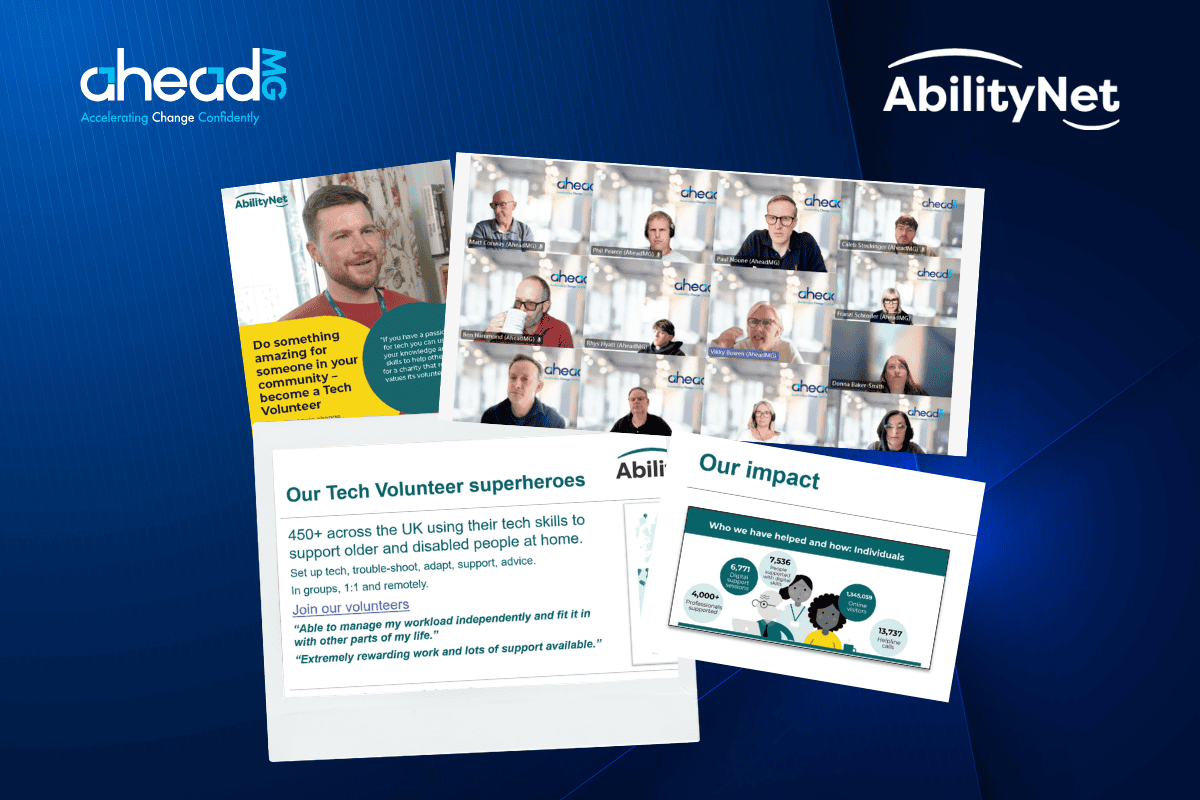
Corporate partnerships are hugely important to AbilityNet and, over the past couple of years, the charity has expanded its network of paid digital skills employees from five to 20, demonstrating the tangible impact corporate support can have within our broader community. Demand for AbilityNet’s services is also rising. Donna mentioned that demand is up 25% compared to this time last year.
One point raised during the discussion was that accessibility challenges can begin as early as age 57, which is something many of us did not realise, coming from technical backgrounds. A number of team members mentioned older family members experiencing challenges online, and it really highlighted the value of the services offered. For example, fraud and scam attempts targeting older people are rife. AbilityNet operates a digital helpline to support individuals navigating these challenges and seeking advice online. Free digital skills sessions have also been delivered for groups, helping people spot the signs of scams, understand how to manage them, and stay safer online.
Overall, the session was one we all really enjoyed and learned from. Our work encompasses accessibility testing; however, nothing replaces hearing real-world stories, some of which were shared during the session.
We’ll be sharing more about how we’re looking to grow our commitment to AbilityNet in the coming months. In the meantime, if you’re interested in volunteering or would like to find out more about its work, visit AbilityNet at abilitynet.org.uk